Monday, November 19, 2007

The Legend of Johnny Lang, Part II: What happened to Johnny's gold?

There are many versions of the story of how the Lost Horse Mine got its name. In one, Johnny Lang, while looking for his horse, sat on a rock to dislodge a stone from his shoe. He looked down and saw the yellow gleam of gold. Just then a gang of cattle rustlers--the infamous McHaney Brothers among them--discovered Lang on their turf and threatened him off.

Another version holds that Lang found his straying horse, which was later taken away at gunpoint. After Lang walked back to camp, he was further encouraged by the gang to move on and look for gold "in them thar hills." He discovered the Lost Horse strike and named the mine after his long-gone companion.

The likeliest version, which Lang himself recounted to Bill Keys, holds that the miner stopped by the McHaney's camp near Keys' Desert Queen Ranch to find that the gang had "confiscated" his missing horse. The cowboy gang directed Lang to "Dutch Frank" Diebold's camp where Diebold revealed that he had discovered a large gold strike, but had been unable to claim it because of interference from the McHaneys. Lang purchased the claim rights from Diebold for $1,000 dollars and took on partners with enough resources to mine the site. Eventually, Lang's partners sold off their shares to the local Ryan brothers.

Amalgam--a mixture of quicksilver and gold from which pure gold is later separated--was commonly used to mine the raw ore. Suspicions were aroused when the Lost Horse processing plant's night shift operations, which Lang supervised, produced significantly less amalgam than the day shift. After setting up a sting, the Ryans confronted Lang with a choice: sell his stake or face jail. Lang sold his portion for $12,000 dollars. Soon after, the gold vein was diverted because of an earthquake fault in its path. The mine went dry.

The aging prospector moved into a deserted cabin in a canyon near Hidden Valley, a part of Joshua Tree National Park where cattle rustlers were known to stash their booty. (The canyon was later named Johnny Lang Canyon as the prospector had worked a smaller claim there). Johnny moved into Keys' Desert Queen Ranch for a time. The arrangement was never comfortable because of Johnny's reputation as a thief.

When the Lost Horse Mine was finally abandoned, Lang returned to his former haunting grounds, taking up residence in an old shack that had served as a kitchen.Lang began selling large amounts of gold to Keys, too great a quantity to have come from his small mine in Johnny Lang Canyon. Keys and others believed that Johnny was secretly refining the amalgams he had skimmed and buried in earlier years.

To sustain himself during this time, Lang shot and ate livestock belonging to a local cattleman, C. O. Barker. When his health declined and his eyesight weakened, Lang turned to his burros.

After Bill Keys found Johnny Lang's body, burial was delayed until the cause of death could be determined. According to eyewitnesses, Lang's remains were left intact by coyotes and rodents, most likely because he was so lean. A month later, the coroner ruled that Johnny Lang had died of natural causes. The authorities instructed Keys to bury his body where it lay.

Unfortunately, Johnny Lang was not to rest in peace. In 1983, the old miner's grave was dug up in the middle of the night when raiders removed pieces of his remains, including his skull.

"Several mysteries still surround Johnny Lang," says Ranger Lentz, "such as what he had on him when he died, who dug him up, and why. Most likely," she says, "the perpetrators were looking for gold. Digging for anything is forbidden in the national park, which prohibits gold-seekers from further excavations. In the early 1990s, however, heavy rains caused several of the park's mine shafts to cave in. A lot of people hoped that Lang's treasure would be unearthed. It was never found."

Speculation still runs high that the gold Johnny Lang skimmed from the Lost Horse Mine is buried somewhere in Joshua Tree National Park, possibly in the Lost Horse area.

The question is... where?

Visit Johnny Lang's grave, the Lost Horse Mine, and Desert Queen Ranch in Joshua Tree National Park. For more information, stop at the JTNP Visitors Center on Utah Trail in Twentynine Palms.

Wednesday, November 14, 2007

The Legend of Johnny Lang, Part I:


In 1925, on a winter morning in the Southern California high desert, Johnny Lang rolled up his sleeping bag and packed what remained of his supplies--a half-slice of bacon and a small sack of flour. He'd have to hoof it from his mining site in the Keys View area of what is now Joshua Tree National Park, hoping to catch a freight wagon into Banning, 60 miles away. Gone were his burros. He'd eaten them one by one.

The 75-year-old prospector slung his gear over his shoulder and tacked a note, dated January 25th, to the ramshackle hut that was his home: Gone for grub. Be back soon.

Three months later, while pioneer rancher Bill Keys and two companions were building the road to Keys View, they came upon Lang's mummified body. The burnt remnants of a nearby bush and the thin sleeping bag Lang was wrapped in suggested that the old miner had died when he stopped to make camp.

During the California Gold Rush of 1849, miners bypassed the Southern California deserts in their hurry to get to "gold country." It was not until a decade later that prospectors began to explore the high desert area that is now Joshua Tree National Park. As mines were staked, miners set up camps and built ore-crushing mills near the sites to process their treasure.

Over the years, thousands of miners came and went. Many abandoned their excavations because of the lack of transportation and scarcity of water. By contrast, the nearby city of Twentynine Palms grew up and thrived because of its proximity to the Oasis of Mara. As one of his many exploits, Johnny Lang founded the city's first saloon.

"Johnny Lang is a part of the colorful history of the area, and of the park," says Laureen Lentz, a longtime resident of Twentynine Palms, and since 1992, a ranger at Joshua Tree National Park. "Lang," she says, "is one of the area's more romantic figures."

Born in Texas in 1850, Johnny Lang worked as a cattle rancher. In the 1890s, he and his father moved west with their grazing herds. Soon after, the pair caught gold fever. They gave up their cows to search for the elusive yellow rocks. Eventually, Lang's efforts paid off.

The Lost Horse Mine was the area's most successful mine. Most of the gold the Lost Horse would ever produce--9,000 troy ounces--was extracted during the first ten years of operation, at the turn of the 20th century. Johnny Lang figures in every version of the mine's discovery, the common factor being that the legendary prospector came across the mine while in pursuit of his wandering horse.

Next: What does Johnny Lang have to do with a stockpile of missing gold?

(photos: Johnny Lang, Lost Horse Mine trail in Joshua Tree National Park)

Monday, November 12, 2007

Joshua Tree National Park


Have you ever traveled to a place that once you've arrived, you never wanted to leave? I feel that way about Joshua Tree National Park. There are the unusual rock formations that attract world class climbers, the roadrunners and golden eagles, coyotes and Bighorn sheep, the searing blue sky and twisted Joshua trees that only grow at an elevation of 2,000-6,000 feet.

Northeast of Palm Springs, just south of Twentynine Palms, Joshua Tree National Park has a long, rich history. Chemehuevi and Serrano Indians inhabited this part of the high desert for thousands of years, making camp at the Oasis of Mara ("land of little water"), home of the 29 palms. In the 1800s, cowboys drove cattle through the nearby grasslands. After, gold miners seeking their fortune staked thousands of claims. In the 1920s, the U.S. government offered 160-acre homestead lots to families who built a house on the site and lived in it nine months out of the year.

During the 1930s, Minerva Hoyt, a community activist from Pasadena, also an avid gardener, became alarmed by the destruction of the desert plant life. Mrs. Hoyt, nicknamed "Apostle of the Cactus," lobbied President Franklin D. Rooselvelt, who created Joshua Tree National Monument in 1936. In 1994, the Monument became a national park.

Located where the Colorado and Mojave deserts meet, Joshua Tree National Park sprawls over 1,240 square miles of mountains, valleys, and flatland. Artists paint and photograph the landscape. Hikers, bird-watchers, and nature-lovers stroll and scramble over boulders. My family and I name the giant rocks that look like elephants or whales. The park's other-worldly feel, with its Joshua tree forests, inspired U-2 when Bono and the band members traveled the California deserts to shoot the cover of the award-winning album, The Joshua Tree.

Visit Joshua Tree National Park several months after a heavy rain, and see the abundance of desert flowers.

More desert trivia:The Joshua tree is not really a tree, but a yucca brevifolia, a member of the lily family.

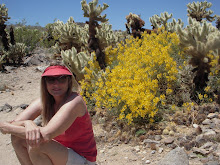
(photos: Joshua Tree National Park 2,000)

Saturday, November 10, 2007

Pioneer Days in Twentynine Palms


Twentynine Palms, a high desert city 128 miles east of Los Angeles, 40 miles northeast of Palm Springs, is located between between the Marine Corps Air Ground Combat Center, the largest marine base in the world, about the size of Rhode island, and the idyllic Joshua Tree National Park (more on the park later...)

During the the 1920s and 30s, homesteaders (the original 29 Palms pioneers) drove Model A and Model T cars over a miner's trail that started in Banning, California, 60 miles west. The city's early residents, many of them World War I vets suffering lung ailments from battle, were sent to this part of the high desert by Pasadena's Dr. Luckie so that their illnesses could be cured in the clean, dry air.

On October 19-21st , 2007, the city of Twentynine Palms hosted its 70th annual Pioneer Days celebration and parade. Grand Marshals Janet Benito Owen and Valerie Hinshaw Hunt, a pair of the early pioneers, rode classic cars on the parade route up Adobe Road.

My father-inlaw, Darold, drove his 1930 Model A in the Pioneer Days Parade. William rode on the running board while my daughter and I waved from our perch in the rumble seat. Residents and onlookers pointed and waved back at us as if we were celebrities. Some good old-fashioned fun!

For trivia buffs:
Twentynine Palms has a population of approximately 28,000 and is at an elevation of 2,000 feet above sea level. The city was named in 1855 when an explorer, Colonel Henry Washington, found an oasis with 29 (a number that has been disputed) palms.

(photos: Pioneer Days parade 2007)

Thursday, November 8, 2007

at the Edge of the Mirage


Each spring, I used to drive to Palm Springs with a group of girlfriends. I thought of the desert as a place to lounge by the pool, go clubbing, enjoy the balmy nights.

Then, 18 years ago, when I started dating my husband William, my experience of the desert changed. His parents live in Twentynine Palms in the California high desert, close to Joshua Tree National Park. I got of the car. We took walks. Walks turned into hikes. I noticed the perfect silence. Then the wind through a spray of creosote, the flap of an eagle's wing. Mountains 20 miles off felt near enough to touch.

Walking in the desert my senses sharpened, maybe from the absence of noise. I saw coyotes, canyon wrens, and packrats. Thousands of plants and shrubs sent up sharp, weedy smells. Ink black nights filled with stars. Mirages shimmered in pools on the asphalt road. Now, day or night--the vastness of the desert inspires me.

I started this blog to share the sights, history, events, and people of the desert--families, tourists, artists, and wanderers. One day, when you stop on a desert road, get out of your car, walk around and experience the landscape up close. The desert will get under your skin. Maybe into your soul...


(photos: Joshua Tree National Park 2005)